Series B Funding: Your Deadline, Not Advantage
Startups, Series B, Technical Hiring, Growth, Leadership
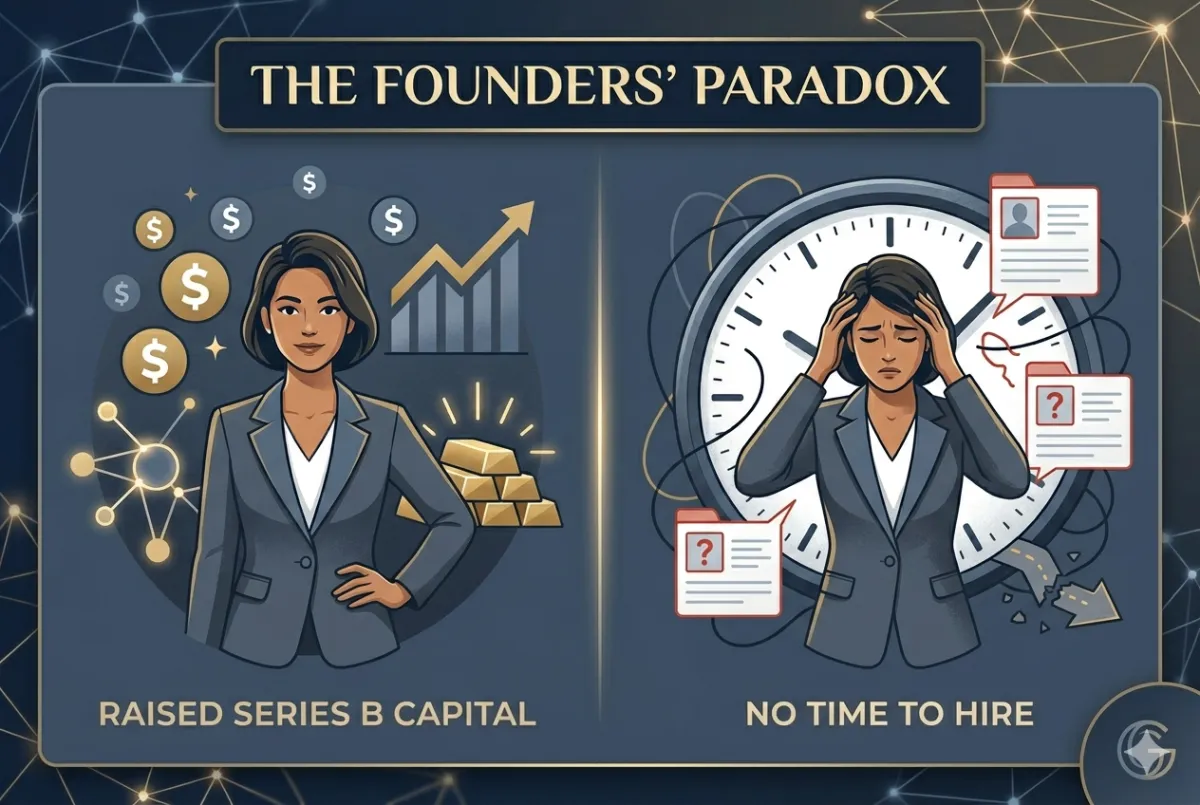
Your Series B Funding Is Not Your Advantage. It Is Your Deadline.
Series B is not the victory lap founders imagine. It is the moment the scoreboard switches from belief to proof. The money does not guarantee growth; it compresses time. From this point on, you are no longer judged on vision, charisma, or market decks. You are judged on execution. And execution, more than anything else, depends on the quality and speed of your hiring.
The Series B Paradox: Funding Doesn’t Create Growth. It Exposes What Is Already Broken.
Series A is about proving there is something worth building. Series B is about proving you can build it at scale. That is where the paradox begins: capital does not fix weak systems. It magnifies them. What felt like “early-stage chaos” at ten people becomes existential risk at fifty. What looked like a “temporary hiring gap” becomes a structural constraint when you are trying to triple product velocity in twelve months.
Tech roles are not disappearing; they are shifting toward AI, cloud, and platform engineering. The bar is higher, the skills are more specialized, and the margin for hiring error has shrunk. When you close a Series B, you are stepping into this market with a clock ticking over your head.
Investors are no longer asking, “Can this exist?” They are asking, “Can this scale, predictably, under pressure?” The answer depends less on your pitch deck and more on your hiring system. Because product roadmaps do not execute themselves. People do.
The Reality of the “Noise” Economy
The technical hiring market you raised into is not the same one that existed even three years ago. It is noisier, more crowded, and more distorted by automation on both sides of the table. Recruiters are overwhelmed. Founders are frustrated. Candidates are confused. Behind all of it is one hard truth: volume has become a liability, not an asset.
Companies are getting flooded with applicants, yet actual completed hires are dropping. Only a tiny fraction of applicants are ultimately hired, even as offer acceptance rates stay high. You are not struggling to attract attention. You are struggling to find signal in the noise.
For early-stage teams, this noise is annoying. For a Series B company, it is dangerous. Your roadmap is tightly coupled to specific, high-impact hires: the staff engineer who can own your AI infrastructure, the platform lead who can modernize your deployment pipeline, the security engineer who can keep you compliant as you scale into the enterprise. When these roles get lost in a sea of applications, the cost is not just “time to hire.” It is delayed revenue, slower product velocity, and a weaker position in a market that is moving faster than your process.
📌 Key Takeaway: In the noise economy, your challenge is not sourcing more candidates. It is designing a system that reliably surfaces the right ones before the clock runs out.
The Velocity Gap: When the Market Moves Faster Than Your Hiring
Most founders underestimate the mismatch between how fast they need to hire and how slowly the market actually moves. Time-to-hire for many organizations often stretches well beyond a month, especially for complex roles. Meanwhile, top-tier technical candidates—especially in AI, data, and cloud—are off the market in under two weeks. They juggle multiple offers and move decisively.
That creates a velocity gap: your process is built for 45–75 days, while the best people are making decisions in 7–14. Every extra interview loop, every week you spend debating a job description, every delay in scheduling a final conversation widens that gap. By the time you are ready to decide, the right candidate is already shipping code somewhere else.
💡 Pro Tip: If your hiring process cannot credibly move from first conversation to offer in under 14 days for priority roles, your Series B roadmap is already at risk.
The AI Filter Problem: When Everyone Sounds Brilliant
AI is reshaping recruitment on both sides of the equation. On the employer side, AI tools can cut time-to-hire by quickly ranking applicants and automating scheduling. On the candidate side, AI is quietly rewriting resumes, optimizing LinkedIn profiles, and generating polished interview answers. Over half of candidates now use AI to enhance their materials and responses. The result: your first impression of a candidate is increasingly synthetic.
None of this is inherently bad. AI can reduce bias, improve consistency, and streamline logistics. But it creates a new challenge for Series B teams: the AI filter collapses the distinction between presentation and capability. Candidates who have never touched production-scale systems can now describe them convincingly. Junior developers can sound like seasoned staff engineers. Generic answers can masquerade as thoughtful strategy.
When your hiring system is not designed to pierce that layer, your funnel fills with people who look strong on paper, speak fluently about concepts, but cannot actually deliver in your environment. At Series B, you do not have the luxury of discovering this six months after hire. By then, the damage is already done—missed milestones, re-architected features, and a team that has quietly lost confidence in leadership’s hiring judgment.
The Quality Dilution: When Volume Masks Reality
In a market where AI-enhanced resumes are the norm, the gap between apparent quality and actual quality widens. Less than 20% of applicants for technical roles are truly qualified, and in many cases the number is much lower. Apply-to-hire conversion rates often hover well below 1%—roughly one hire for every hundreds of applicants. Recruiters are handling more applications, but hires per recruiter are dropping.
This is quality dilution. When everyone looks strong on paper and sounds coherent in a first interview, your funnel becomes a mirage. You feel like you have options, but very few are truly capable of owning the kind of end-to-end systems modern Series B companies rely on—AI-driven products, multi-cloud architectures, complex data pipelines, or security-critical infrastructure. Volume becomes your biggest liability, because every additional unqualified candidate consumes time, attention, and leadership focus you cannot get back.

Excess candidate volume quietly drains leadership focus long before a single offer is made.
The Cost No One Tracks: Leadership Debt and Hiring Drag
Most founders can tell you their burn rate instantly. Far fewer can tell you their hiring drag—the hidden cost of leaders spending their scarcest resource, focused time, on screening, interviewing, and triaging candidates instead of driving the roadmap. This is leadership debt: the compounding impact of decisions that pull your most critical people away from the work only they can do.
Technical hires routinely require dozens of interviews and many hours of interviewer time. Multiply that by a handful of roles and you have weeks of leadership time spent inside calendars instead of code, customer conversations, or strategic planning. Meanwhile, every unfilled technical role can conservatively cost thousands of dollars per day when you factor in:
Delayed product releases and feature launches
Missed market windows or competitive responses
Increased load on existing team members, driving burnout and attrition
Slower experimentation cycles, reducing learning and compounding returns
At Series B, you are not just burning dollars. You are burning momentum. The opportunity cost of leadership time diverted into resume review and first-round interviews rarely shows up on a P&L, but it absolutely shows up in your product velocity and market position twelve months later. The more your leaders are trapped in a broken hiring system, the less they are leading.
📌 Key Takeaway: Leadership debt is as real as technical debt. If you do not deliberately design your hiring system, it will quietly design your calendar—and your company’s ceiling—for you.
Why Traditional Recruiting Is Failing Series B Companies
Most recruiting models were built for a different era. They were optimized for volume:
More candidates per role
Faster submissions to hiring managers
More activity-based metrics—calls, emails, outreach volume
In a world where resumes were a reasonable proxy for skill and AI was not rewriting everyone’s story, this approach made sense. Today, it does not. In a market driven by AI-enhanced profiles, volume creates risk. Every extra candidate who “seems strong” but cannot actually execute in your environment adds friction, not options. You do not need more resumes. You need certainty.
The companies that continue to rely on traditional, volume-based recruiting models pay for it in three ways:
Decision fatigue. Too many “good on paper” candidates lead to endless comparison, delayed decisions, and a higher chance of settling for mediocrity.
Process drag. More interviews, more debriefs, more conflicting signals from different interviewers—without better outcomes.
Misaligned incentives. External recruiters are often rewarded for speed and volume, not long-term quality of hire, retention, or impact.
At Series B, this model is not just inefficient—it is incompatible with your reality. Your hiring is no longer an HR function. It is a growth function. The people you bring in now will define your culture, your architecture, your customer experience, and your ability to raise the next round on your terms. You cannot afford a system that treats them like interchangeable names in a spreadsheet.
The GemTek Approach: ConnectAIve Intelligence™
GemTek was built for this new reality. We are not a recruiting firm you simply “add” to your vendor list. We are a system you install. Our ConnectAIve Intelligence™ process is designed to cut through the noise, neutralize AI-driven polish, and deliver the one thing your Series B company actually needs from hiring: confidence in execution.
Capability Over Polish
ConnectAIve Intelligence™ starts with a simple premise: what matters is what candidates can actually do, not how well they describe it with AI assistance. We focus on:
Real-world technical assessments tied to your actual stack and constraints, not generic coding puzzles
Scenario-based conversations that reveal how candidates reason about trade-offs, risk, and scale
Evidence of ownership—systems they have built, incidents they have led, migrations they have survived
We use AI where it helps—structuring data, spotting patterns, accelerating logistics—but we never confuse AI-polished narratives with genuine capability. The result is a shortlist of candidates whose skills have been validated against the work they will actually do for you.
Alignment First: Culture, Leadership, and the Series B Reality
Technical excellence without alignment is a short-term win and a long-term problem. Before a candidate ever reaches your leadership team, we evaluate:
How they operate under ambiguity and shifting priorities—the daily reality of a Series B company
Their expectations around pace, autonomy, and ownership
Their ability to collaborate with product, design, GTM, and leadership stakeholders
Alignment is not a “nice to have.” At this stage, a misaligned senior hire can set your roadmap back quarters. That is why culture and leadership fit are not an afterthought in our process—they are a gate.
Precision Delivery: 1–2 Candidates Built for the Role
Traditional recruiting celebrates sending you a “robust slate” of candidates. We celebrate something very different: delivering one to two candidates who are truly built for the role and your stage. That is not a lack of effort. It is a reflection of the rigor we apply before anyone reaches your calendar. Because by the time we ask your leadership team to invest their time, we expect them to be evaluating “who” and “when,” not “if.”
💡 Pro Tip: The cost of reviewing the wrong candidates is higher than the cost of waiting for the right ones—especially when your leaders are the ones doing the reviewing.
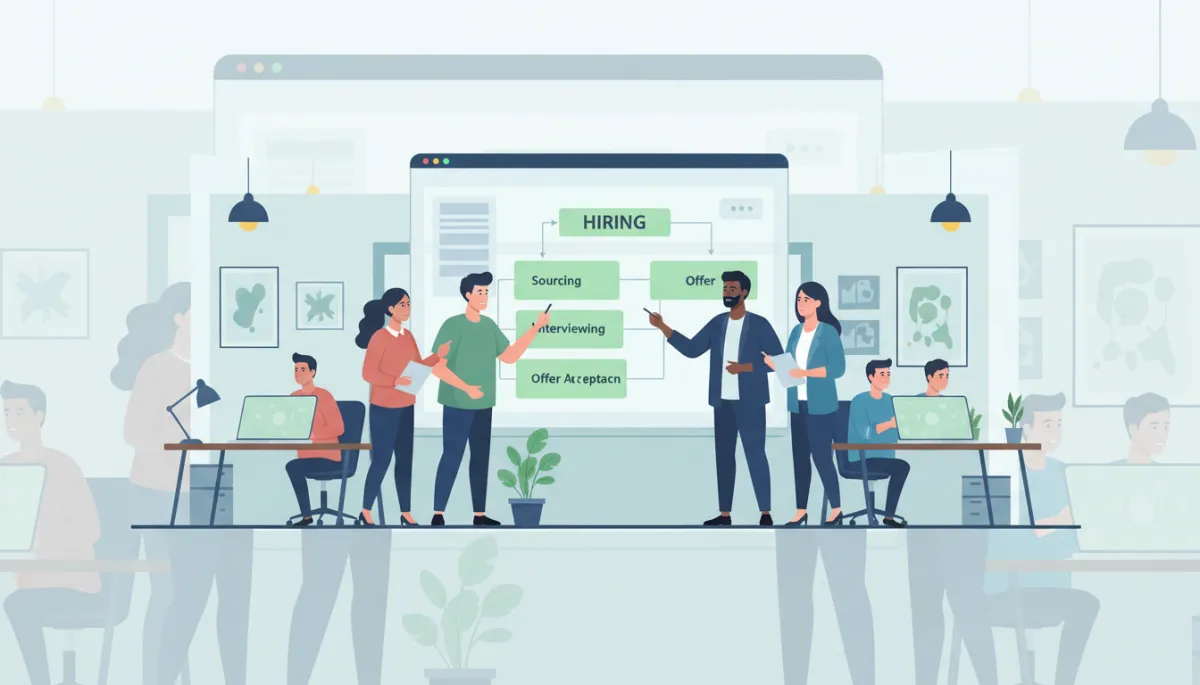
Founding team and head of engineering reviewing a clear hiring funnel dashboard on a large...
A visible, systematized funnel turns hiring from chaos into a controllable growth lever.
Is Your Hiring Approach Scalable—or Just Busy?
A simple diagnostic can tell you whether your current hiring system can support your Series B ambitions. Ask yourself:
Are critical technical roles open for more than 30 days? If yes, your time-to-hire is out of sync with the market and your roadmap.
Is your leadership team overwhelmed with applications? If they are spending hours each week in early-stage interviews, you have a system problem, not a talent problem.
Do you rely on “gut feel” more than structured evidence? If your debriefs sound like “I liked them” more than “Here is how they handled X scenario,” you are exposing yourself to bias and inconsistency.
Are your best candidates dropping out or going dark? That is often a sign your process is too slow, too noisy, or too confusing.
The companies that scale successfully from Series B are not always the fastest-growing on paper. They are the ones who make the right hiring decisions sooner. They design hiring systems that respect the velocity of top talent, the scarcity of leadership time, and the reality of the AI-driven noise economy. They treat every open role as a strategic decision, not a checkbox.
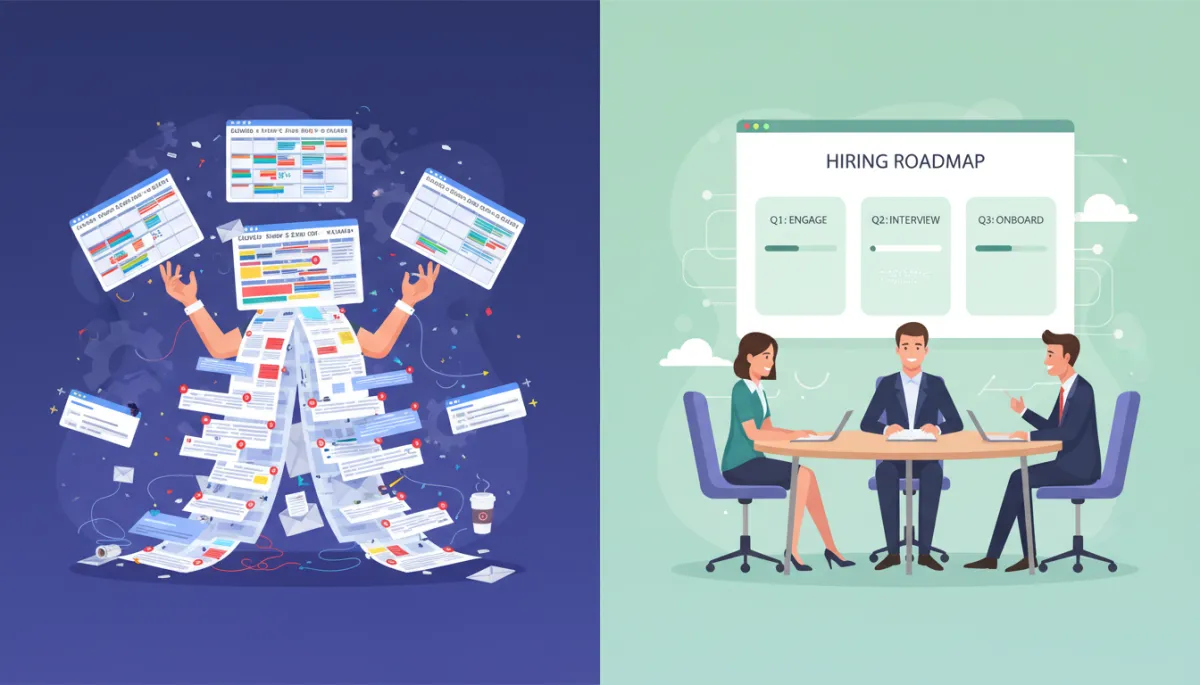
Split-screen comparison of two startups, one side showing chaotic calendars and overflowing...
Busy teams drown in activity; scalable teams focus on the few hires that move the needle.
Secure Your Growth Roadmap: Turn Your Series B Deadline Into an Advantage
Your Series B funding did not solve your hiring challenges. It made them impossible to ignore. You are now operating on a compressed timeline where every quarter matters, every release window is visible to competitors, and every key hire either accelerates you toward your next milestone or slows you down just enough to miss it.
If you have three or more critical technical roles open—or expect to in the next 90 days—this is not a future problem. It is a present-tense risk. The good news is that risk is manageable when you treat hiring as the growth function it actually is and install a system designed for today’s market, not yesterday’s assumptions.
📌 Next Step: A focused 15-minute diagnostic can reveal where your hiring system is leaking time, quality, and leadership attention—and what to change first.
GemTek’s ConnectAIve Intelligence™ is built for founders and leadership teams who understand that their Series B is not a trophy. It is a countdown. Our work together is simple in intent and rigorous in practice:
Replace volume with precision—fewer candidates, higher certainty.
Replace guesswork with evidence—real assessments, real alignment, real track records.
Replace leadership drag with leverage—a system that protects your time while increasing your confidence in every hire.
At this stage, indecision is itself a decision. Every month you operate with critical roles unfilled, or filled by the wrong people, you are quietly choosing slower growth, weaker execution, and a harder fundraise story later. The companies that turn their Series B into a true inflection point are the ones who confront this reality early and redesign hiring with the same rigor they apply to product and go-to-market.
You do not need a bigger recruiting “machine.” You need a sharper one—one that filters out AI-polished noise, respects the speed of top talent, and gives your leadership team back the time and clarity to actually build the business you just raised money to scale. That is the shift from treating hiring as a necessary cost to treating it as a non-negotiable core competency of a durable company.
If you are serious about making your next twelve months your strongest operating year—not just your most expensive—start by upgrading the system that determines who gets a seat on the bus. Turn your Series B from a countdown into an advantage by making every key hire a deliberate, evidence-backed decision instead of a rushed compromise.
If you are ready to turn your Series B from a silent source of pressure into a clear roadmap for growth, start by getting your hiring system under control. The capital you raised has already started the clock. Now it is time to make sure the people you bring in can help you beat it.
Secure your growth roadmap today:
Email: [email protected]
Visit: gemtekrecruiting.com
Schedule a 15-minute hiring diagnostic and get your roadmap back on track.